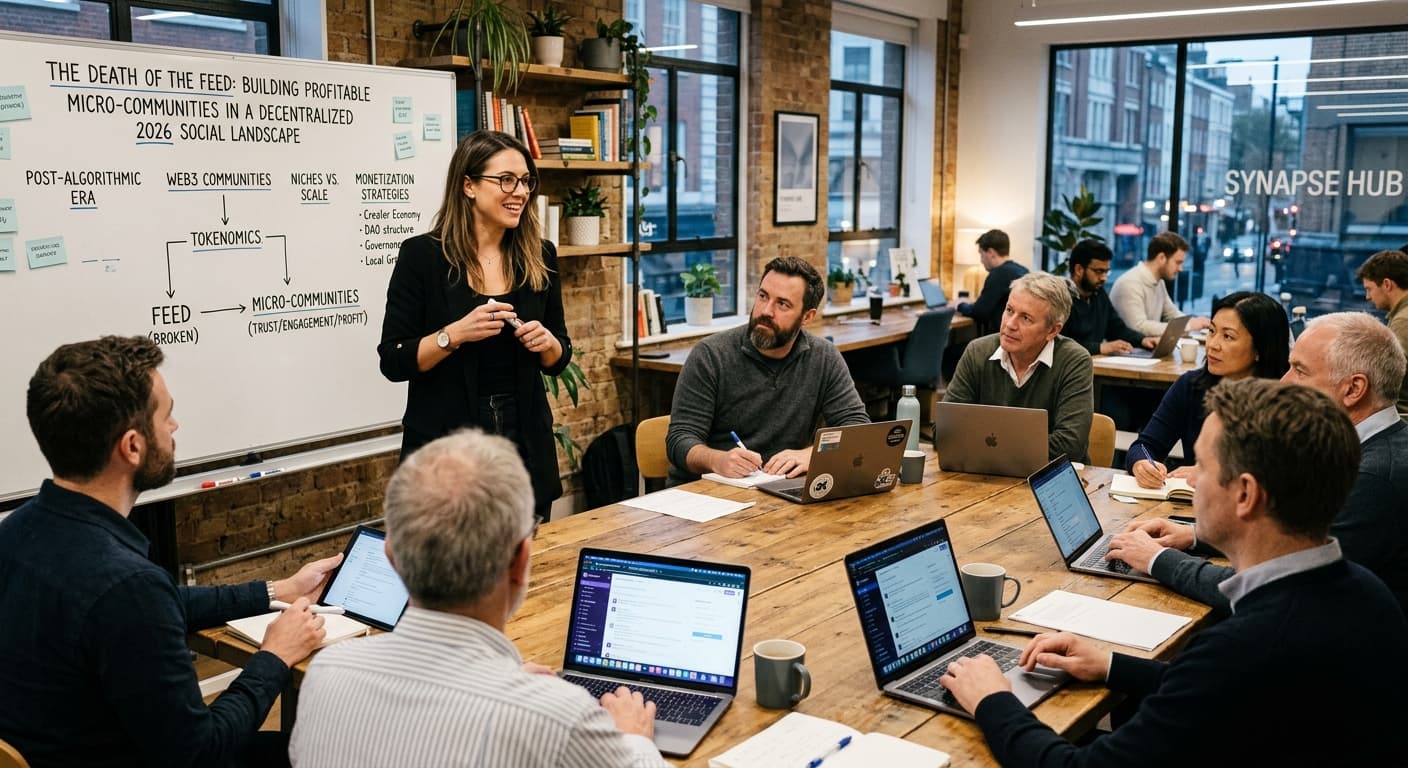
Remember 2021? The algorithm determined your reality. You scrolled, you consumed, and you were advertised to. Your brand’s survival depended on gaming the likes of Instagram or Facebook. By 2023, the cracks were showing. Users were exhausted by performative content, overwhelmed by ads, and distrustful of monolithic platforms that traded their data for relevance.

The Great Shift of 2026: From Algorithm to Authenticity
Welcome to 2026. The centralized feed is dead. The algorithmic echo chamber has collapsed under its own weight. In its place, we find a fragmented, exciting, and far more profitable new continent: the decentralized web, populated by thriving micro-communities.
This isn't a dystopian prediction; it's the inevitable evolution of the internet. The ‘death of the feed’ isn't a shutdown of social media; it's a shift in how we connect. It’s the move from broad, shallow interactions to deep, specialized, and inherently valuable relationships.
For forward-thinking brands and creators, this isn't a crisis. It's the ultimate opportunity. The brands that will dominate 2026 are not the ones with the largest follower count on a single, fragile platform. They are the ones that are building and nurturing profitable, micro-communities across a decentralized landscape.
What Does the Decentralized Landscape Look Like?
In 2026, the internet doesn't have a single entry point like the Facebook wall or Twitter feed. It is a vast, interconnected network (the Fediverse, and many other names). Instead of one or two dominating “town squares,” we have thousands of “village commons,” each specialized, user-owned, and interconnected.
1. The Rise of the Fediverse
The Fediverse, powered by protocols like ActivityPub and AT Protocol, has exploded. It’s a network of independent servers (nodes) that can communicate. Users own their data and their identity. They can migrate from one server (e.g., a Mastodon instance for knitting) to another (e.g., a Lemmy community for astrophysics) without losing their followers or their social capital. For a brand, this means you can’t just rely on ‘algorithm hacking.’ You must contribute genuine value to individual communities, or you will be ignored (or blocked).
2. The Era of Token-Gated Communities (DAOs and Social Tokens)
Community building has gone hyper-niche and hyper-capitalized. Brands and creators build deep, locked-door communities (think highly-evolved Discord or Telegram) where access is granted not by clicking 'like,' but by owning a unique NFT or a creator-specific social token. This immediately filters for high-intent participants and creates a tangible value proposition.
3. Peer-to-Peer Networks and Private Spaces
The open web is for discovery, but the relationship is forged in privacy. Users are increasingly retreating to smaller, invite-only group chats (WhatsApp, Signal, private Discord channels) and even peer-to-peer networks that bypass a central server entirely. These ‘dark social’ channels are harder to track, but they are where the deepest brand loyalty is formed.
Building a Profitable Micro-Community: The 2026 Playbook
The old strategy of ‘post and pray’ is officially obsolete. Building a profitable micro-community in 2026 requires a radical shift in mindset: from broadcaster to facilitator.
Step 1: Discover Your Niche (and Then Niche Down Again)
In a world of fragmented networks, ‘general interest’ is dead. You cannot be “a coffee brand.” You must be “the ethical, low-acid, small-batch, crypto-enthusiast coffee brand.” Your micro-community must be built around a specific, shared obsession. The smaller and more fervent the niche, the more valuable the community.
Step 2: Define the 'Utility' of the Community
A community must provide tangible value. Why should someone participate? In 2026, this is about more than just conversation; it’s about access. Your micro-community could offer:
Exclusivity: Access to a core team, founders, or expert advice (the 'token-gated' model).
Knowledge: Deep-dive education, curated information, or early market intelligence that can’t be found anywhere else.
Co-creation: Allowing community members to vote on future products, features, or content, giving them a stake in the outcome (the DAO model).
Commerce: Exclusive discounts, early product drops, or a community-run marketplace.
Step 3: Move from 'Content' to 'Contribution'
On decentralized networks, nobody wants your marketing department's pre-scheduled content calendar. They want your expertise and your participation. A brand in a decentralized space succeeds by being an active, helpful, and transparent community member. You contribute to discussions, share knowledge (even if it's not directly related to your product), and provide value without expecting anything in return (initially).
Step 4: Architecting the Profitability (The New Monetization)
The days of CPM (cost per thousand views) ads are done in these spaces. Profitability in a micro-community is earned, not bought. Here is the new monetization hierarchy:
Membership Fees / Token Access: The direct model. Users pay to access the community, creating recurring revenue. (e.g., A creator’s token gives access to a private Discord).
Community Commerce: Selling products or services designed for and often co-created by the community. (e.g., A special edition coffee blend designed by the DAO).
Trusted Affiliate: Recommending tools, services, or other communities that truly provide value, and being rewarded for that trusted recommendation. (The old affiliate model, but with radical transparency).
Crowdfunding/Sponsorship: The community funds a project (e.g., a new feature, a research paper) that they directly want.
Step 5: Master Decentralized Discovery
You may not have a centralized feed, but you still need discovery. Discovery in 2026 relies on:
Community Crossposting: Sharing relevant value (not just ads) into other relevant decentralized communities, using proper ‘village etiquette’ (tagging, relevance).
Thematic Aggregators: Utilizing and supporting tools (like new-age RSS readers and niche search engines) that aggregate content from across the Fediverse.
Trust-Based SEO: Optimizing for specialized, intent-driven searches, not broad keywords. In 2026, SEO will be more about becoming the authoritative answer in a highly specific, niche context.
The Future is Small, Deep, and Intensely Valuable
The death of the feed is not the end of social. It is the beginning of connection. Building profitable micro-communities in a decentralized 2026 isn't just an alternative marketing tactic; it is the new standard of online business.
It requires more effort, a different skill set (more empathy, less automation), and a long-term vision. But the reward—unshakeable brand loyalty, a higher customer lifetime value, and a resilient business that doesn't depend on a single, volatile platform’s algorithm—is more than worth the shift.
The era of broadcasting is over. The era of belonging has begun. Welcome to the future.